Hawaiʻi Budget Primer FY2026–27 Budget Tracker ↗ Download PDF
Hawaiʻi Appleseed — Center for Law & Economic Justice

HAWAIʻI
BUDGET
PRIMER

FY2026–27
Hawaiʻi Appleseed — Center for Law & Economic Justice

Author: Devin Thomas

Hawaiʻi Appleseed is committed to a more socially and economically just Hawaiʻi, where everyone has genuine opportunities to achieve economic security and fulfill their potential. We change systems to address inequity and foster greater opportunity by conducting data analysis and research to address income inequality, educating policymakers and the public, engaging in collaborative problem solving and coalition building, and advocating for policy and systems change.

The work of Hawaiʻi Appleseed is about people. The issues we work on—housing, food, wages, mobility, the state budget and taxation, and racial and indigenous equity—are important because they ensure people have access to shelter, sustenance, and the means to survive and thrive individually and collectively. Addressing these issues requires the knowledge and expertise of the people that have first-hand experience and live with the adverse consequences of our flawed systems.

TABLE OF CONTENTS

Budget Basics3
How Money Is Spent5
Funding the Budget8
Endnotes12
2 • BUDGET PRIMER

BUDGET BASICS

THE INVESTMENTS that Hawaiʻi’s government makes in its people through the state budget should reflect our shared priorities and values. This budget primer is intended to help readers understand how our state budget works and to encourage policy decisions that lift up Hawaiʻi’s working families.

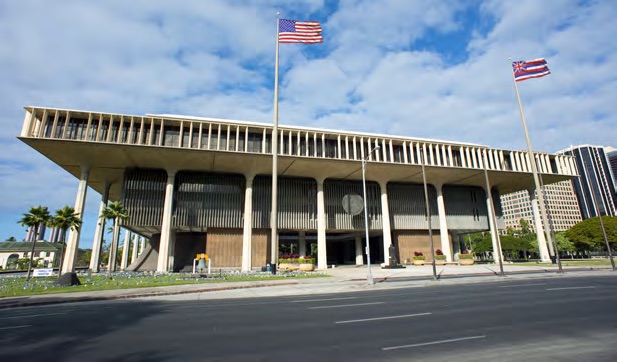
The state budget funds Hawaiʻi’s three government branches: the Legislature; the Judiciary; and the Executive. A small portion funds the Office of Hawaiian Affairs (OHA) as well. Nearly 99 percent of the state budget goes toward funding the executive branch.

Legislature

Legislature

  • Creates laws and decides how the state’s money is spent.
  • Consists of the State Senate and House of Representatives, Office of the Auditor, Office of the Ombudsman, and the Legislative Reference Bureau.
Judiciary

Judiciary

  • Interprets laws and resolves legal cases through the court system.
  • Consists of the Hawaiʻi Supreme Court, Intermediate Court of Appeals, Land Court, Tax Appeal Court, Circuit Courts, Family Courts, District Courts, Environmental Courts, and Office of the Administrative Director of the Courts.
Executive

Executive

  • Enforces laws and manages the daily operations of the state government.
  • Consists of the Governor, Lieutenant Governor, State Departments, and the University of Hawaiʻi System.
Office of Hawaiian Affairs

Office of Hawaiian Affairs

  • Responsible for improving the wellbeing of Native Hawaiians.
  • Semi-independent state agency that is mostly funded by public trusts and its own investments.
BUDGET PRIMER • 3

Budget Process

Hawaiʻi uses a two-year (biennial) budget cycle. The full budget is passed in odd-numbered years, and adjustments can be made in the second year. Fiscal Years (FY) cover July 1 through June 30, labeled by the calendar year in which they end (e.g. FY 2027 runs from July 2026 through June 2027).

Figure 1. Hawaiʻi Budget Lifecycle

JANFEBMARAPRMAYJUNJULAUGSEPOCTNOVDECLegislative considerationPlanning and prep by B&F DeptPrep of proposed exec budget
DECThe governor submits the executive budget proposal to the legislature.
JAN–APRThe legislature reviews, amends and passes the budget bill.
MAYEmergency and supplemental appropriations are added if any are needed.
JUNThe governor signs the budget bill into law, with line-item veto power.
JULFunds are released to executive departments and agencies.
AUG–SEPAgencies carry out spending.
OCT–NOVBudget proposals are drafted by each branch.
4 • BUDGET PRIMER

HOW MONEY IS SPENT

Government spending is essential for the economy, especially in times of crisis. The executive branch alone employs over 47,000 workers, not including contractors.1 These employees are in charge of Hawaiʻi’s departments and agencies—a task that is only made possible with billions of dollars in funding.

There are three types of spending: operating, capital improvement, and one-time/emergency appropriations.

Operating Budget

  • Regular funding for state agencies, public services, and programs.

Capital Improvement Appropriations

  • Funds to build, maintain, or improve infrastructure, such as roads, schools, and hospitals.

One-Time & Emergency Appropriations

  • Temporary funding for unexpected needs, such as disaster response or special projects.

Since it manages the state’s departments and agencies, the Executive Branch receives almost all of the funds in each spending category.

Table 1. Budget Breakdown by Branch and Spending Category, Hawaiʻi,

Executive2Judiciary3 Legislature45OHA67
Operating Budget$20.32 billion$218.77 million $52.82 million$6 million
Capital Improvement Appropriations$4.53 billion $45.4 million$0$0
One-Time Appropriations$997.87 million$684,385 $0$55 million
Emergency Appropriations$2.87 million$0 $0$0
Total $25.85 billion$264.85 million $52.82 million$61 million
BUDGET PRIMER • 5

Spending Categories

Operating Budget

Figure 2. Hawaiʻi State Budget by Branch and Department, — click a department for details & tracker link

$0B$1B$2B$3B$4B$5BJudiciary$265MLegislature$52.8MOHA$61MHuman Services$5BTransportation$4.9BBudget, Finance$4.4BEducation$3.8BHealth$2.6BUH System$1.6BBus, Econ, Dev, Tour$662MLand, Natural Res$585MLabor$483MAccounting, Gen Serv$583MCorrections$322MAgriculture$167MDefense$154MAttorney General$138MHwn Home Lands$131MCommerce$109MLaw Enforcement$103MTaxation$43.8MHuman Resources$36MGovernor$4.93MLt. Governor$2.5M
Operating Budget
Capital Improvement Appr
One-Time Appr
Emergency Appr

Note: Some capital dollars appear under the department that builds a project — the Department of Accounting and General Services, for example, often manages construction on behalf of other departments.

For detailed, program-level data on the state budget: Explore the interactive Budget Tracker →

The Executive departments with the largest overall budgets are the Departments of Human Services, Transportation, Budget and Finance, and Education. The Department of Transportation’s Capital Improvement Appropriations budget is larger than its operating budget—the state’s airports, harbors, and highways are in the middle of a multi-year construction cycle. The Department of Health has a larger operating budget than all but three departments, and the DOE operating budget covers K–12 public school teacher salaries statewide.

6 • BUDGET PRIMER

Obligated Costs

Before any other spending, the Hawaiʻi constitution requires the state to pay its non-negotiable obligated costs: pensions, health benefits, Medicaid, and debt payments—roughly $5 billion, or a quarter of the operating budget. This share is growing each year, limiting the state’s flexibility to invest in housing, schools, economic development, and climate resilience.

View Obligated Costs

General-fund obligated costs, FY2018–FY2027 ($Billions).8 Hover a year for the breakdown.

$0B$1B$2B$3B$4B$5BFY18FY19FY20FY21FY22FY23FY24FY25FY26FY27$3.64B$5.03B
Retirement (ERS)
Health Benefits (EUTF)
Medicaid & Entitlements
Debt Service

Except for Medicaid, covered under the Department of Human Services, these costs fall under the Department of Budget and Finance—the two departments with the largest operating budgets, both dominated by obligated costs.

General-fund fixed costs have climbed from $3.64 billion in FY2018 to $5.03 billion in FY2027. Source: “Statewide Totals by Fixed vs. Non-Fixed (General Funds),” p.18 of each biennium’s Hawaiʻi Executive Budget in Brief.

Capital Improvement Appropriations

Figure 3. Distribution of Capital Improvement Project Funding, ($Millions)

$2,691$880$419$342$203
Transportation
Formal Education
All Others
Economic Development
Health

The total FY2027 Capital Improvement Projects (CIP) budget is $4.53 billion. Transportation projects usually take more than half, maintaining the state’s airports, harbors, and 2,433 miles of roads and highways.9

One-Time and Emergency Appropriations

Plus further one-time appropriations for UH student housing, ACA premium support and school meals, and $2.9 million in FY27 emergency appropriations.

View all appropriations

FY27 One-Time Appropriations

  • $700M Transportation & Budget/Finance — county-surcharge transit funding ($600M) and a new major disaster fund ($100M), under Act 99.10
  • $200M Accounting, Transportation, Land — Maui wildfire insurance proceeds, to rebuild King Kamehameha III Elementary and restore Lahaina’s harbor.11
  • $49.5M DBEDT — the New Aloha Stadium district.12
  • $28.5M UH — revenue bonds for student housing.13
  • $16.5M Human Services — health-plan premium support for residents losing ACA coverage.14
  • $3.4M Education — free school meals for all ALICE households, the FY27 expansion promised in Act 139 (2025).15 Act 236 also lowered the share of meal-preparation costs schools must cover.

FY27 Emergency Appropriations

  • $2.87M Various Executive Departments — collective-bargaining cost items for Bargaining Unit 11 employees ($2,871,954).16
  • ~$110M FY26, also passed in the 2026 session — a $14.2M backfill of funds redirected to food assistance during the 2025 federal shutdown, and $95.8M for labor-grievance cost items.17
BUDGET PRIMER • 7

FUNDING THE BUDGET

Figure 4. Hawaiʻi Budget Means of Finance, ($Billions)18

$10.6(52.4%)$4.4(21.6%)$3.7(18.1%)$1.6(7.9%)
General Funds
Special Funds
Federal Funds
Other Funds

Note: A few smaller related categories, including “other federal funds,” are currently grouped into “Other Funds”

The state’s spending primarily falls under three main categories: general funds, special funds and federal funds.

General Funds

  • General funds are mostly made up of tax revenue. The main pot of state money, these funds can be used for almost any state need.

Special Funds

  • Money from tuition, fees, settlements, etc., special funds can only be spent on a specific purpose, often related to the revenue source.

Federal Funds

  • Federal funds are monies provided to the state by the federal government, almost always in the form of grants.
8 • BUDGET PRIMER

Taxes

Figure 5. Projected Hawaiʻi State Tax Revenue, ($Billions)19

$5.56(53.1%)$2.98(28.4%)$0.77(7.4%)$0.71(6.8%)$0.45(4.3%)
General Excise Tax
Individual Income Tax
Transient Accommodations Tax
All Other Taxes
Corporate Income Tax

General Excise Tax

  • The GET is a tax on the sale of goods and services such as retail purchases and rent. Hawaiʻi relies on the GET for half of the state’s tax revenue, but the tax increases the cost of living and hits low-income families the hardest.

Individual Income Tax

  • Hawaiʻi taxes those with high incomes at a progressively higher marginal rates. With the passage of Act 25, the new top rate for people earning over $1 million will be set at 13 percent.

Transient Accommodations Tax

  • The TAT is a tax on hotel rooms, short-term rentals and cruise ships. It is paid mainly by tourists and supports the general fund and special funds for tourism promotion, resource management, climate resiliency and economic development.
BUDGET PRIMER • 9

Who Pays These Taxes?

Figure 6. Percentage of Income Paid in State and Local Taxes by Household Income Quintile (2024)20

14.1%Lowest 20%Less than $21,90013.7%Second 20%$21,900–$44,20014.2%Middle 20%$44,200–$80,10013.4%Fourth 20%$80,100–$136,60011.8%Next 15%$136,600–$278,20010.2%Next 4%$278,200–$594,90010.1%Top 1%Over $594,900

In Hawaiʻi, low- and middle-income families spend a larger share of their already stretched income on state and local taxes than wealthy families do. This is mostly due to the GET: a low-income and a wealthy person pay the same dollar amount on the same purchase, but that amount is a far larger share of a low-income paycheck—making it harder to budget for, and often trapping families in cycles of poverty and debt.

This reality is particularly difficult for Native Hawaiians and Pacific Islanders, who report poverty rates of 20 percent—double the state average for Hawaiʻi.21 Historically, Native Hawaiians have faced systemic issues rooted in colonization: throughout the 1800s, large tracts of land that once provided for communities were taken by Western settlers, who built plantations and then resorts for their own benefit. For many Native Hawaiians, this shift led to a rise in food insecurity and reduced access to affordable housing.

Hawaiʻi must build a tax system that supports these marginalized groups, by reducing their taxes and investing tax dollars in policies that lower the cost of living. Tax credits (and other forms of assistance) are an excellent way to give people of color and low-income communities more leeway to pay for their basic necessities.

Act 46 

Although Act 46 (2024) lowered income taxes for most people in Hawaiʻi, wealthier taxpayers benefited the most. In addition, these tax cuts would have eventually cost the state $1.45 billion every year by 2031.22 This path was not sustainable—it would have led to severe budget cuts, including programs such as SNAP and Medicaid.

With the passage of Act 24 in 2026, the Legislature decided to keep these planned tax cuts for low- to middle-income residents, while raising taxes on people earning over $1 million. Unfortunately, these changes will not recover all of the revenue lost from Act 46. Hawaiʻi also needs to prepare for deep federal spending cuts. In order to do that, the state must consider all the revenue tools at its disposal.

10 • BUDGET PRIMER

Making Hawaiʻi’s Tax System Fairer

These three policies would raise revenue from those best able to pay more, without affecting working families.

1

Tax Investment Profits Like Paychecks

Up to $132M a year

Hawaiʻi taxes long-term capital gains at 7.25 percent, while wages are taxed up to 13 percent. As a result, someone who earns their income working a regular job pays potentially more than an investor who profits off their stocks.23

Over 70 percent of capital gains flow to households making more than $400,000. Taxing them as ordinary income would raise around $85 million to $132 million in new revenue a year, with 88 percent of it coming from the top 1 percent.

2

Modernize the Conveyance Tax

$70M - $80M a year

Paid when a property changes hands, the conveyance tax is one of the few tools that allows the state to capture revenue from Hawaiʻi’s real estate market.24 Its rates have not moved since 2009, even though out-of-state buyers have continued to drive up housing prices by turning homes into investment properties.

House Bill 2049 (2026) would have shifted the tax to marginal rates—cutting it for most residents, while raising it on high-value investment properties. The bill would have directed up to $300 million a year to the General Fund, various affordable housing funds, and the Department of Hawaiian Homelands.25

3

Close Corporate Loopholes

+$85M a year

Multinational corporations are able to shift profits they earn in Hawaiʻi to other jurisdictions to avoid being taxed on them.26 Worldwide Combined Reporting would close that loophole, holding large corporations to the same standard as small businesses and working families.27

Tax Credits

Tax credits can lower or even eliminate the taxes that people or businesses owe to the state. These tax credits stimulate the economy by reducing costs either for businesses or struggling families that need help purchasing their basic necessities.

In 2022, the state gave out $433.9 million in tax credits.28 Only $111 million went to tax credits for lower-income households, such as the Earned Income Tax Credit and Refundable Food/Excise Tax Credit, while a larger $168 million went to tax credits for wealthier taxpayers and businesses, such as the Film/Media Production Credit.

The state should be investing more money in tax credits and other means of lifting up working families. It could, for example, create a state-level Child Tax Credit (CTC). At the national level, the CTC brought 2.9 million children out of poverty in 2021. Other options include programs like RxKids—which has successfully delivered millions of dollars in no-strings-attached benefits to mothers with infants throughout Michigan.

BUDGET PRIMER • 11

ENDNOTES

  1. “State of Hawaiʻi Executive Branch Workforce Profile,” Hawaiʻi State Department of Human Resources Development, p. 5, December 16, 2024. https://dhrd.hawaii.gov/wp-content/uploads/2024/12/Workforce-Profile_06302024_FINAL.pdf
  2. “Act 175,” State of Hawaiʻi, June 26, 2026 (HB1800 CD1). https://www.capitol.hawaii.gov/sessions/session2026/bills/HB1800_CD1_.HTM
  3. “Act 178,” State of Hawaiʻi, 2026 (HB2095 CD1), amending Act 227, Session Laws of Hawaiʻi 2025. https://www.capitol.hawaii.gov/sessions/session2026/bills/HB2095_CD1_.HTM
  4. “Act 1,” State of Hawaiʻi, 2026 (HB2240 HD1). Includes the act’s accrued-vacation payouts (§12) and the $6.8 million audit revolving fund authorization (§8), but not the separate $2.8 million deposit into that fund (§7), which would double-count. The FY2025–26 figure follows the prior edition, which included the deposit and predates the Act 127 cost items. https://www.capitol.hawaii.gov/sessions/session2026/bills/HB2240_HD1_.HTM
  5. “Act 127,” State of Hawaiʻi, May 29, 2025 (HB1439 CD1), FY2026–27 legislative cost items. https://www.capitol.hawaii.gov/sessions/session2025/bills/HB1439_CD1_.HTM
  6. “Act 248,” State of Hawaiʻi, June 30, 2025 (HB410 CD1). https://www.capitol.hawaii.gov/sessions/session2025/bills/HB410_CD1_.HTM
  7. “Act 32,” State of Hawaiʻi, May 22, 2026 (SB903 CD1), one-time $55 million public land trust transfer to OHA for FY2026–27. https://www.capitol.hawaii.gov/sessions/session2026/bills/SB903_CD1_.HTM
  8. “Executive Biennium Budget, FB 2025–2027,” Hawaiʻi Department of Budget and Finance. https://budget.hawaii.gov/budget/executive-biennium-budget-fiscal-budget-2025-2027/
  9. “Visitor Info,” Hawaiʻi Department of Transportation. https://hidot.hawaii.gov/highways/visitor
  10. “Act 99,” State of Hawaiʻi, June 5, 2026 (HB2275 CD2). https://www.capitol.hawaii.gov/sessions/session2026/bills/HB2275_CD2_.HTM
  11. “Act 123,” State of Hawaiʻi, June 8, 2026 (SB2930 CD1). https://www.capitol.hawaii.gov/sessions/session2026/bills/SB2930_CD1_.HTM
  12. “Act 184,” State of Hawaiʻi, July 6, 2026 (SB2599 CD1). https://www.capitol.hawaii.gov/sessions/session2026/bills/SB2599_CD1_.HTM
  13. “Act 80,” State of Hawaiʻi, June 4, 2026 (HB2339 CD1). https://www.capitol.hawaii.gov/sessions/session2026/bills/HB2339_CD1_.HTM
  14. “Act 21,” State of Hawaiʻi, May 21, 2026 (HB2310 CD1), Part II. https://www.capitol.hawaii.gov/sessions/session2026/bills/HB2310_CD1_.HTM
  15. “Act 139,” State of Hawaiʻi, May 30, 2025 (SB1300 CD1), §3–4. https://www.capitol.hawaii.gov/sessions/session2025/bills/SB1300_CD1_.HTM
  16. “Act 26,” State of Hawaiʻi, May 22, 2026 (HB2272 CD1). https://www.capitol.hawaii.gov/sessions/session2026/bills/HB2272_CD1_.HTM
  17. “Act 21” Part I and “Act 33,” State of Hawaiʻi, May 2026 (HB2310 CD1; HB2271 CD1). https://www.capitol.hawaii.gov/sessions/session2026/bills/HB2271_CD1_.HTM
  18. “Act 175,” State of Hawaiʻi, June 26, 2026 (HB1800 CD1). https://www.capitol.hawaii.gov/sessions/session2026/bills/HB1800_CD1_.HTM
  19. “State Receipt and Revenue Plans FB25–27,” Department of Budget and Finance, September 2024. https://budget.hawaii.gov/wp-content/uploads/2024/12/05.-State-Receipt-and-Revenue-Plans-FB25-27-PFP7Lt.pdf
  20. “Hawaiʻi: Who Pays? 7th Edition,” Institute on Taxation and Economic Policy, 2024. Note: Includes all family sizes. https://itep.org/whopays/hawaii-who-pays-7th-edition
  21. “Poverty Status in the Past 12 Months,” American Community Survey 1-Year Estimates (Table S1701), U.S. Census Bureau, 2024. https://data.census.gov/table/ACSST1Y2024.S1701?q=poverty+ethnicity&g=040XX00US15&moe=false
  22. Kawafuchi, Kurt, “General Fund Forecast,” Council on Revenues, March 12, 2025. https://files.hawaii.gov/tax/useful/cor/2025gf03-12_with0416_Rpt2Gov.pdf
  23. “Hawaiʻi’s Two-Tier Tax System,” Hawaiʻi Appleseed. https://hiappleseed.org/blog/hawaii-two-tier-tax-system-glaring-loophole-rich-pay-less
  24. “Modernize the Conveyance Tax,” Hawaiʻi Appleseed. https://hiappleseed.org/blog/fair-share-hawaii-future-modernize-conveyance-tax
  25. “House Bill 2049,” Hawaiʻi State Legislature, 2026. https://www.capitol.hawaii.gov/session/measure_indiv.aspx?billtype=HB&billnumber=2049&year=2026
  26. “Tax Loopholes for Multinational Corporations,” Hawaiʻi Appleseed. https://hiappleseed.org/blog/hawaii-tax-loopholes-multinational-corporations
  27. “Revenue Effect of Mandatory Worldwide Combined Reporting by State,” Institute on Taxation and Economic Policy. https://itep.org/revenue-effect-of-mandatory-worldwide-combined-reporting-by-state/
  28. “Tax Credits Claimed by Hawaiʻi Taxpayers: Tax Year 2022,” Hawaiʻi Department of Taxation, p. 5, December 2024. https://files.hawaii.gov/tax/stats/stats/credits/2022credit.pdf
12 • BUDGET PRIMER